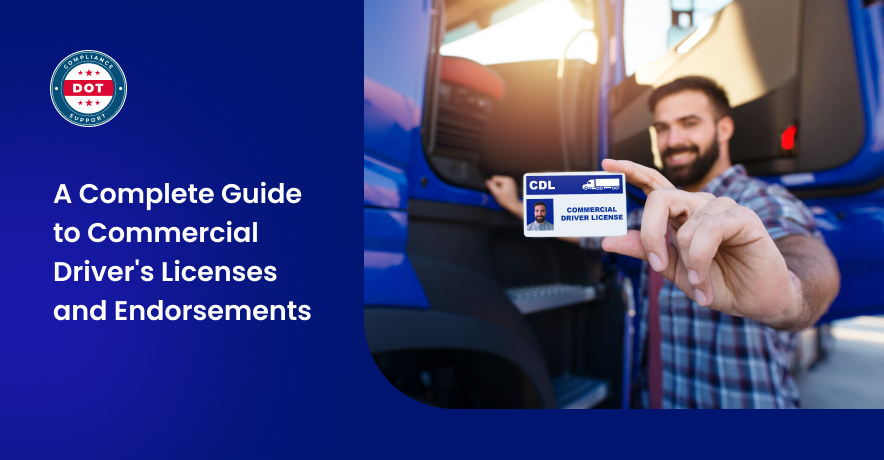
A Complete Guide to Commercial Driver's Licenses and Endorsements
Commercial trucks move the majority of freight across the United States, creating ongoing demand for qualified commercial drivers. While earning potential varies by route, experience, and freight type, drivers who obtain the right endorsements often qualify for higher-paying opportunities.
This guide explains CDL classes, endorsements, licensing requirements, and key considerations that can help drivers and carriers stay compliant and make informed decisions.
What Is a CDL?
A Commercial Driver's License (CDL) is the federal credential required to operate heavy or specialized commercial vehicles. Without one, a driver is limited to non-commercial vehicles - think pickup trucks, not big rigs.
The program itself is regulated by the Federal Motor Carrier Safety Administration (FMCSA). FMCSA sets the training and qualification standards; state DMVs issue the actual license. Every state follows the same federal framework, so the requirements don't vary much from one to the next.
CDL Classes: A, B, and C
The class of CDL you need comes down to the vehicle you'll be driving. It's worth getting this right before applying - choosing the wrong class typically means sitting through knowledge tests again.
| Class | What You Can Drive | Weight Rating | Common Jobs |
| Class A | Combination rigs (tractor-trailers) | GCWR 26,001+ lbs, trailer over 10,000 lbs | OTR, flatbed, tanker |
| Class B | Single heavy vehicles | GVWR 26,001+ lbs | Dump trucks, delivery, city buses |
| Class C | Smaller CMVs hauling passengers or hazmat | Under 26,001 lbs | Shuttles, hazmat vans |
Class A covers the broadest range of vehicles. Because it applies to the heaviest combinations, a Class A CDL also permits operation of Class B and Class C vehicles, provided the driver holds the appropriate endorsements. For this reason, most new drivers pursue Class A first.
For fleets, interstate operation also depends on having MC Authority filings in place before trucks cross state lines.
What Are CDL Endorsements?
Endorsements are single-letter codes added to a CDL, each representing an additional test (or set of tests) a driver has passed. They authorize drivers to haul freight types that go beyond standard dry van loads.
Most endorsements require a written exam, some require a road test, and a few require a TSA background check. Without the relevant endorsement, drivers are not legally permitted to haul that type of freight, and carriers will not assign it.
The 6 Main CDL Endorsements in 2026
The federal endorsements are defined in 49 CFR § 383.93:
| Code | Endorsement | What It Covers | Tests Required |
| H | Hazardous Materials | Placarded hazmat loads | Written + TSA background check |
| N | Tank Vehicle | Liquids or gases of 1,000+ gallons | Written |
| P | Passenger | 16+ passengers (driver counts) | Written + skills |
| S | School Bus | School bus operation | Written + skills + background check |
| T | Doubles/Triples | Two or three trailers | Written (Class A only) |
| X | Hazmat + Tanker | Hazmat in tankers | H and N combined |
The Hazardous Materials (H) endorsement has the most demanding requirements. Drivers must pass a written knowledge test covering safe handling procedures and federal regulations, and complete a Transportation Security Administration (TSA) security threat assessment. Details on this process are available on the TSA's HME page.
Carriers transporting hazmat freight must also maintain HAZMAT registration with PHMSA. This is a company-level responsibility, separate from the driver's individual endorsement.
How to Get Your CDL: Step by Step
- Meet the age requirement: 18 for intrastate work; 21 for interstate operation or any hazmat-related driving.
- Pass a DOT physical through a certified medical examiner.
- Obtain a Commercial Learner's Permit (CLP) and hold it for at least two weeks.
- Complete Entry-Level Driver Training (ELDT) through a provider listed on the FMCSA Training Provider Registry.
- Pass the written knowledge tests at your state DMV.
- Pass the skills test, covering pre-trip inspection, basic vehicle control, and an on-road driving evaluation.
- Pay the applicable fees to receive the license.
New hires should also be aware that carriers are required to complete a Drug and Alcohol Clearinghouse query before a driver's first dispatch. Maintaining accurate DOT records is equally important - a single missed filing can affect an entire fleet's ability to operate.
How Endorsements Affect 2026 Pay
As of May 18, 2026, the average annual pay for a CDL truck driver in the United States is $73,147, with drivers in the 90th percentile earning approximately $94,000 annually. Drivers at the higher end of that range typically hold hazmat, tanker, or combined endorsements.
Industry salary data from TruckersHire's 2026 breakdown indicates that specialized freight - including hazmat, oversized loads, and auto transport tends to pay meaningfully more than standard dry van freight, often in the range of 10 to 20 percent.
Drivers who obtain the X endorsement (hazmat plus tanker) may qualify for specialized freight opportunities that often get them higher pay than standard freight operations.
Owner-operators should also note that UCR registration must remain current each year, as lapses may result in penalties, enforcement actions, or operational disruptions.
CDL Restrictions Worth Knowing
Restrictions function as the inverse of endorsements: they indicate what a driver is not authorized to do until the corresponding test is passed.
- L — No air brake-equipped CMV
- Z — No full air brakes
- E — No manual transmission
- M — No Class A passenger vehicle
- N — No Class A or B passenger vehicle
- O — No tractor-trailer
- V — Medical variance documentation required
Each restriction remains in effect until the driver passes the relevant test. Carriers verify these restrictions, so they should not be overlooked.
How DOT Compliance Support Helps
Licensing is only part of staying road-ready - the paperwork side is where most drivers and fleets fall behind.
DOT Compliance Support handles DOT registration, MCS-150 biennial updates, IFTA quarterly returns, and BOC-3 process agent appointments, and ensures UCR renewals are filed ahead of the December 31 deadline each year.
Final Word
A CDL gets you on the road. The endorsements behind it largely determine what that road pays. Drivers holding specialized endorsements such as hazmat, tanker, or combination credentials often qualify for a wider range of freight opportunities and may earn higher compensation than drivers without those endorsements.
The path itself isn't complicated: pick the right class, build an endorsement stack that fits your goals, and keep compliance current. If the paperwork side of that equation is slowing you down, DOT Compliance Support can take it off your plate.
FAQs
How long does it take to get a CDL in 2026?
For most people, four to eight weeks - the mandatory 14-day CLP hold sets your floor, and ELDT plus testing fills in the rest. Some candidates move faster depending on school availability and how quickly they can schedule their skills test.
What does a CDL cost?
When you add up tuition, testing fees, and state costs, most drivers land somewhere between $3,000 and $7,000 total. Some carriers will cover that cost if you sign a service agreement, so it's worth asking before you pay out of pocket.
Which endorsement pays the most?
The X endorsement (hazmat plus tanker) is commonly associated with some of the highest-paying specialized freight opportunities available to CDL drivers.
Do endorsements require ELDT?
For first-time H, P, and S endorsements, yes - this requirement has been in effect since February 7, 2022. Full details are available on the FMCSA ELDT page.